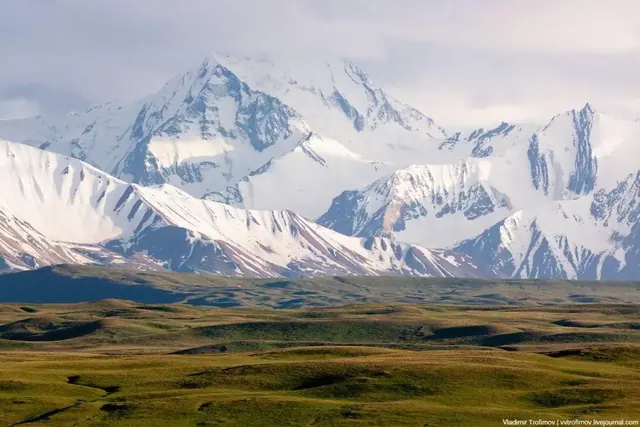
 Osh · 685 km · 9.4 h
Alay Valley
Cold plateau at about 3,000 m with Lenin Peak (7,134 m) of the Pamir on the horizon
Chinese law does not allow foreign companies to make films in mainland China on their own, and foreigners need a special permit even to enter the Tibet Autonomous Region, so Tibet itself is rarely an option for a foreign crew. Nepal has the real Himalaya but charges location fees from US$1,500 to US$5,000 per area and many high locations have no road. Kyrgyzstan offers 7,000 m peaks, cold high plateaus and stone buildings in empty valleys, reachable by road, at about $2,600 per shooting day.
Major films set in Tibet were shot elsewhere: Seven Years in Tibet (1997) recreated Tibet in Argentina's Mendoza province after the production moved from Ladakh, and Kundun (1997) was shot mostly at the Atlas studios in Ouarzazate, Morocco. What a production needs is the look: thin-air light, bare high valleys, snow peaks on the horizon and stone architecture.
Nepal issues filming permits through the Ministry of Communication and Information Technology, with a local coordinator applying on the producer's behalf. Location consents carry their own fees: US$1,500 for the Annapurna, Manaslu and Gaurishankar conservation areas for non-SAARC productions, plus 25% for aerial filming, and US$5,000 each for Upper Mustang and Upper Dolpa. The Everest region has no road: crews fly to Lukla, whose 527 m runway takes only small aircraft in good weather.
Without Buddhist monasteries or prayer flags, which need set dressing, these locations give the landscape and the scale.
Osh · 685 km · 9.4 hCold plateau at about 3,000 m with Lenin Peak (7,134 m) of the Pamir on the horizon
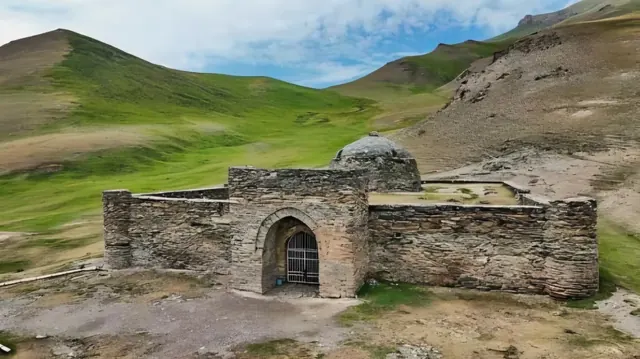 Naryn · 435 km · 6.5 h
Stone caravanserai of 31 rooms in a remote valley above 3,200 m
 Naryn · 497 km · 7.1 h
Lake at about 3,500 m on a bare plateau near the Torugart Pass
 Naryn · 426 km · 6.9 h
Miniature canyon at about 3,500 m
 Issyk-Kul · 565 km · 11.2 h
Remote town on the way to the Inylchek Glacier
 Naryn · 366 km · 5.4 h
High pastures with a sacred site of seven springs
We can run a location scout specifically for your script.
Updated: 2026-10-20